Saturday, September 18, 2004

On the commutativity of college semesters

My dorm has a bathroom in each wing that alternates between being a men's room to being a women's room at the start of each semester. Since the bathroom closest to me is a women's room, I have to use the men's room on the second or fourth floor until the configuration is switched next semester.

I asked myself yesterday, "Is it better to have the bathroom first semester or second semester?" Does it make a difference? I thought that it did. Even had I not been comfortably situated in my corner room so close to the staircase that takes leads me to either 2 mens bathrooms of my choice, I am instilled with the hope that next semester, I will be able to get to the bathroom in 22 steps. To get staight to the point, trips to the shower this semester will be sweetened by the hope of an easier journey next semester. Next semester begins the slow progression where I am pampered and spoiled by having the bathroom on my side of the floor.

How I pity those who live close to the urinals and bathroom stalls their first semester. Their semesters are poisoned by the unstoppable march towards the end of the semester when their precious bathroom will be uprooted and installed 22 steps beyong the threshold Room 308. My year consists of 1) Hope and 2) Luxury while their year will begin with 1) Dread and 2) Torture.

So, I guess semesters are not commutative.

Thursday, September 02, 2004

Who carries societies burdens?

How does society organize the lives of millions of people into a stronger whole? Well, we have a set of rules that we arrived at by a consensus of our representatives to create government for the people, by the people, of the people to make sure that our society is preserved and strenthened. This government costs money and it's said that taxes are the price we pay for civil society. Who pays? Everyone, to the extent that they can afford to do so. In reality, because of the way wealth is distributed in our country we all know that the wealthiest individuals contribute the largest chunk of governement tax revenue and the poorest contribute little to nothing.

I was reading Kerry's speech at Georgetown, entitled "A Return to Fiscal Responsibility" when I got to this part:
But that is not the reason for our own budget crisis. The independent, non-partisan Congressional Budget Office reported last month that 94 percent of the $500 billion deficit for next year is due to George Bush's excessive spending and ineffective tax giveaways for the wealthiest Americans. In fact, his tax cuts alone account for most of the long-term deficit increase.
Because the administration's own analysis where the economy was to blame for around 50% of the this year's deficit, I did some investigating and came across numerous accounts of an August Congressional Budgeting Office report providing analysis on how Bush's string of tax cuts are actually shifting more of the burden of funding our government off the backs of the upper classes (top 20% and up) and onto everyone else, namely the middle class. From the first article I read by Robert Novak (you know, the one who leaked the identity of Valarie Plame):
That study concluded that President Bush's cuts had shifted more of the tax burden from the nation's rich to the middle class, though everyone enjoyed an income tax reduction. That was the old-fashioned way of scoring consequences of tax legislation, an exercise of arithmetic rather than economics.

Kerry could not have been happier. ''This is the straw that will break the back of middle-class families,'' proclaimed a written statement by the senator.
I'm thinking, if this is such big news, how did I miss it? Then I realize that in following the whole Swift Boat distraction, this news went right over my head. The majority of news sources reported the same thing, that the richest were benefiting the most from Bush tax cuts. Some of the leads were quite inane, saying the richest received cuts 70 times larger than the average family. As the mantra meant to convey fairness and equity goes goes, the more you pay in taxes, the more you get back in tax cuts.

That all makes sense, right? If I paid 70 times more in taxes than you did, shouldn't my tax cut be 70 times larger than yours? Well, things started getting more complicated when you read different takes on the CBO report. What you'll see are a whole other set of analyses that seem to contradict the 'pessimistic' interpretation and say that in fact, Bush's tax cuts not only leave more money in peoples' pockets, they have made the tax system more progressive than before. National Review Contributing editor Donald Luskin writes a piece called Liberal Lies, CBO Truths lambasting the Wall Street Journal, Washington Post, and New York Times as misinterpretations that "completely distort the findings of the CBO report."

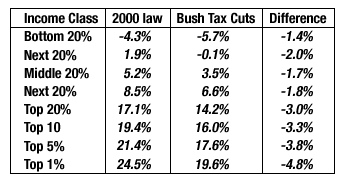
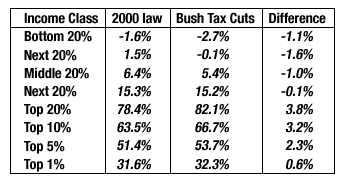
To substantiate his case, he charts two sets of information organized by income level/tax bracket:

Tax reduction from 2000 tax law,
and Share of income-tax burden,

We can see from the first graph that while the equitability of Bush's tax cuts sounds like a redeeming rationale, they are far from equitable. The WSJ headline actual makes a powerful point: "Budget Office Says Biggest Tax Cuts Go to Richest 1%." No one is making the inane complaint that the rich get "bigger" breaks in the sense that they're getting more dollars back, since that would be usually be equivalent to the statement, "the rich make more money." With a 4.8% cut in income-taxes, they get a significantly larger proportion, not just amount, of their taxable income returned. The average return any member in the top 20% bracket received a 3% return. The next quintile received even less at 1.8%, followed by 1.7%, 2.0% and 1.4%. This results in the vast majority of the taxes being given to the richest 1%, not simply by virtue of their contribution to the federal budget, but from the tax breaks being heavily weighted towards the rich.

This data begs the following questions: if Bush tax cuts could be weighted towards the rich, what caused them to weigh them this way? Couldn't they have increased the middle class tax cut, because these are the people who have the most pent up demand and are have a great deal to contribute to the economy? Giving the rich such relatively heavy tax cuts costs the government a proportionally great deal of money, whereas giving more substantial cuts to the middle class wouldn't be nearly so costly. Remember that even according to the Bush administration, tax cuts costed us a quarter of the highest budget deficit ever, not counting the money spent from the Social Security "surplus". I don't claim any expertise in understanding the economic effect of Bush's tax cuts, but according to 10 Nobel-prize winning economists who endorsed Senator Kerrry, Bush's 'fiscal policy' has mostly created low-paying jobs and is endangering our economy in the long run.

From the second chart, Luskin points out the almost magical effect of Bush's tax cuts in altering the income-tax burdens that made our system more progressive than under 2000 law. The share of total tax collected by the government afforded by the top quintile overtook 3.8% of the burden from the lower four quintiles. If you're wondering how that's possible considering how how much larger the cut's per dollar paid in taxes were for the top quintile than the lower four, I'm asked myself the same question.

This mysterious outcome moved me to check out the actual CBO report, Effective Federal Tax Rates Under Current Law, 2001 to 2014, to find out for myself who's headline was more accurate? Is it true that "the burden of taxes has shifted from the wealthy to the middle class"? Or are the liberals distoring the truth, as according to the National Review? How can the tax burden shift towards the middle class while the rich—who undeniably benefitted disproportionally from Bush's three tax cuts—are paying more taxes?

After reading the report, it became apparent that the evidence from both takes on Bush's tax cuts are accurate, but the analysis on the parts of those attacking liberal periodicals like the Wall Street Journal were lacking comprehension. As it turns out, all of the quantitative assertions were true. The rich did get higher tax cuts as Lusking charted. They did end up footing more of the individual income-tax burden. And, yes, the second and third highest quintiles (middle class?) together ended up with a .9% increase in Total Federal Tax Liability. In 2004, the first quintile together ended up with a smaller share of the total tax burden, namely with 1.8% of the overall tax burden being shifted to the rest of America from the top 1% of earners.

Here's a direct quote from the CBO concerning the trend going out to 2014:
The differential increase in effective tax rates among quintiles is reflected in a shift down the income distribution in shares of taxes paid (see the third and fourth panels of Table 2). The share of taxes paid by the top quintile falls from 65.3 percent in 2001 to 62.8 percent in 2014, even though that group's share of income does not change. Four-fifths of that decline occurs for the top 1% of taxpayers, whose share falls by 2 percentage points, to 20.7 percent of federal taxes in 2014. The share of taxes paid by each of the middle three quintiles climbs by about 0.7 percentage points.
Two questions came to mind. What is the difference between a share of the individual income-tax liability and the total federal tax liability? Also, how can these numbers be reconciled? From the wording of the report, the total federal tax liability of the two tax burdens, is clearly more significant. Income-tax represents a significant fraction of all the taxes Americans pay to the federal government, but is supplemented by other forms of taxes.

What Luskin did, was to consider a shift in a fraction of the total tax burden more significantly than the entire tax burden at large. He also doesn't recognize that it's illogical for the top 1% are getting disproportionately large tax cuts and still have them carry more of their shares of the tax burden (note in differences in referring to income-tax and total tax) than before the tax cuts. According to FactCheck.org, census figures from August 23 suggest that the middle class didn't grow, but rather shrunk by 1.2 percentage points. Therefore, a growth in the middle class might not account for the larger share of the overall tax burden. Granted that the definition of the middle class is not set in stone, if considering the information laid out here, claims by Luskin and other contrarians that the liberal media is distoring the truth are ungrounded. In principle, everyone shoulder's societies burdens to the extent at which they can, but there should be no mistake. In principle, Bush's tax cuts disproportionately benefitted the wealthy.

UPDATE: For a great quantitative analysis of the tax burden shift, check out Chris's Boring Tax Stuff post on My Quiet Life.

Friday, August 27, 2004

Iraq in retrospect

CNN.com - Retiring GOP congressman breaks ranks on Iraq - Aug 18, 2004


When Doug Bereuter, R-NE, submitted a 4-page statement about why in retrospect and after much consideration, he feels the military action in Iraq was a mistake, some make accusations that the retiring vice-chair of the House Select Committee on Intelligence from Nebraska is just bitter and spiteful for "having been passed over ... to head the intelligence and international relations committees." But others disagree: "Doug has been exceptionally self-sacrificing, not noisy (or) abrasive, and certainly not self-serving. His focus has been on serving the best interest of the country and his district, and not on self-promotion."

Kerry won't say he regrets his vote authorizing Bush to invade Iraq, but Bereuter says given what he knows now, he would have voted differently. He also felt it was still inconclusive as to "whether intelligence was intentionally miscontrued to justify military action."

Whether or not you believe the war was justified, here are some ways we could've really supported our troops 100%:
  • If we didn't disband the Iraqi Army we wouldn't be fighting so many of them as insurgents (and losing men doing so).
  • It was also wrong to place reconstruction and the interim governement in the hands of the DoD rather than the State Department (not sure why he says this, but maybe because the State Department would've done a better job and looked better doing it).
  • We could have not "ignored military leaders who warned many more troops would be needed in Iraq to maintain the postwar peace." (Franks himself said he was expecting 150,000 international peacekeapers. I wonder if Bush knew that when he asked the UN inspectors to get out and declared his 48-hour deadline.)

  • So, Bush might have declared the WoT, but he's certainly not doing a mighty fine job of it.

    SOURCE: The Online Beat and CNN
    First posted in my Xanga

    Wednesday, August 25, 2004

    Kerry Wins Backing from Nobel Economics Laureates

    This is what I'm talking about!

    I was at a store today with my mom and she complimented an employee's outfit. The woman replied with a smile, "Well it's one job to the next." That struck me as being very poignant. I've been living life thinking about what I want to do for a living in the future and here's someone thinking about how many jobs she needs to work to support her family.

    From Reuters via commondreams.org:
    PHILADELPHIA - John Kerry won the endorsement of 10 Nobel Prize-winning economists on Wednesday as he attacked President Bush for policies that he said have led to the creation of only low-paying jobs.

    The Democratic presidential nominee released a letter from the economists saying the Bush administration had "embarked on a reckless and extreme course that endangers the long-term economic health of our nation."

    They cited "poorly designed" tax cuts that instead of creating jobs have turned budget surpluses into enormous budget deficits, a "fiscal irresponsibility threatens the long-term economic security and prosperity of our nation."

    The endorsement, in the form of an open letter American voters, was signed by George Akerlof and Daniel McFadden of the University of California at Berkeley, Kenneth Arrow and William Sharpe of Stanford University, Daniel Kahneman of Princeton University, Lawrence Klein of the University of Pennsylvania, Douglass North of Washington University, Paul Samuelson and Robert Solow of MIT and Joseph Stiglitz of Columbia University.

    ...continued

    A 'disengaged' president?

    When we vote this election, in many ways it's not a vote for Bush or Kerry but for the Republicans or Democrats. Now I know this is old news but in Suskind's The Price of Loyalty, interviews with Bush administration insiders (primarily with Paul O'Neill) among other things, shed light on how powerful members of the administration use various means to sway the president, from repitition of ideas like 'the upper class are the entrepreneurs' to 'Stick to principle':
    “He asks, ‘Haven't we already given money to rich people? This second tax cut's gonna do it again,’” says Suskind.

    “He says, ‘Didn’t we already, why are we doing it again?’ Now, his advisers, they say, ‘Well Mr. President, the upper class, they're the entrepreneurs. That's the standard response.’ And the president kind of goes, ‘OK.’ That's their response. And then, he comes back to it again. ‘Well, shouldn't we be giving money to the middle, won't people be able to say, ‘You did it once, and then you did it twice, and what was it good for?’"

    But according to the transcript, Karl Rove jumped in.

    “Karl Rove is saying to the president, a kind of mantra. ‘Stick to principle. Stick to principle.’ He says it over and over again,” says Suskind. “Don’t waver.”

    An interesting characterization of the way this works is an analogy to:
    "a praetorian guard that encircled the president" to block out contrary views.

    They invoke President Reagan:
    "...Cheney, at this moment, shows his hand,” says Suskind. “He says, ‘You know, Paul, Reagan proved that deficits don't matter. We won the mid-term elections, this is our due.’ … O'Neill is speechless.”

    Here's another example of Bush's transformation. Before the election, he was saying that we've got to change the policy of being the world's policeman, going around nation-building:
    "If we don't stop extending our troops all around the world in nation-building missions, then we're going to have a serious problem coming down the road. And I'm going to prevent that."

    Right after Cheney, et. al. got a hold of him, it was all Iraq, all the time:
    “From the very beginning, there was a conviction, that Saddam Hussein was a bad person and that he needed to go,” says O’Neill, who adds that going after Saddam was topic "A" 10 days after the inauguration - eight months before Sept. 11.

    “From the very first instance, it was about Iraq. It was about what we can do to change this regime,” says Suskind. “Day one, these things were laid and sealed.”
    Souce: CBS News

    Saturday, August 21, 2004

    What's a political hack? Click to find out.

    Watch this video from Election 2000 dated February 15, 2000. Keep in mind that two weeks prior, Senator McCain won the third Republican primary in New Hampshire with an 18 point lead. What happened after that is history.

    I really feel bad for John McCain. I also feel bad for George Bush. I honestly don't think that he was unscrupulous enough to inflict such emotionally harming and dishonorable damage to a friend who to this day campaigns for him. However, I certainly don't hold it above his political advisors.

    Karl Rove (who'll probably say he was misquoted): "Political hacks like me wait a lifetime for a guy like this to come along."

    UPDATE 9:19 PM EST: I swear I posted this before I got the email blast from Mary Beth Cahill.

    UPDATE 10:09 PM EST: This ad was released in conjunction with a petition calling on President Bush to condemn the Swiftboat Veterans for Truth ad (the first one was taken off-line and replaced with a newer one that makes different charges) that sought to cast Kerry as someone who lied to receive his medals and lied about war crimes in Vietnam. These allegations are disputed heavily by both sides. Bush has gone out of his way to not personally criticize Kerry's record and refuses to condemn the ad even at the request of Sen. McCain. My personal contention is that Bush's advisors instructed him to take the moral highroad to avoid further scrutiny of his own weak Vietnam record.

    Thursday, August 19, 2004


    A screen shot of a dialog offering SP2.

    Thursday, August 12, 2004

    I'm a student that said yes to CS...

    Students saying no to computer science | CNET News.com

    A Rutgers professor that taught me Computer Architecture, Dr. Saul Levy, is quoted in this article that highlights undergraduate enrollment drops all over the country including at Rutgers, MIT, Stanford, Carnegie Mellon. Ph.D. programs are hit as well.

    This doesn't come as a surprise at all with tales of the IT bust and off-shoring scaring students away. You see people who don't major in Computer Science, or don't major in it exclusively being perfectly capable of doing what we expect CS undergrad majors to do. Make web pages, code scripts and programs, etc. The article doesn't exactly refer to people majoring in CS only to go to work writing business applications, but expresses a concerns or disconcern that our leadership in the Computing field is at stake. The drop in interest also means less people conducting research and advancing the science, solving problems and not just applying learned concepts.

    I'm again reminded as to the problem of how I want to proceed with my college career. Am I motivated enough to succeed in the field or industry? Am I talented enough? Should I dual major as several of my peers have chosen to do? CS/Business isn't exactly out of the question, but will surely require a fifth year. CS/Chinese, CS/PoliSci and CS/Biology are three possible branches of my academic growth.

    I'm too good at putting things off...

    Last minute warning about Google's IPO registration

    Google IPO Update


    Techdirt and the disgruntled investor in this story have it wrong as to why Google rejects bidders, casting some blame on the underwriters. They can't seem to figure out why after answering a bunch of questions in the registration process truthfully, the investor gets a "...we find you are ineligible..." message. They think it might have to do with his net worth not being high enough.

    He tells us his responses to the questions posed by the online form and I bet it's because he told them he was a speculative investor. If he would have just read the prospectus or other stories about how Google is trying to discourage speculative investors (those who are in for quick, risky, and high profits) from participating and increasing the instability/volatility of their stock price, he would have got his bidding registration accepted and by possibly tomorrow night, he'd have his shares of GOOG.

    So... if any of you want to try your hand, remember that when they ask whether "your investment objectives include speculative investments," consider saying NO. By the way... the more I think about this, the more I realize I have no right to give advice of this kind... I not sure that any one answer will really disqualify you. Just read the prospectus, have realistic expectations, trust Google, and answer honestly.

    From Google's Prospectus: "Many companies going public have suffered from unreasonable speculation, small initial share float, and stock price volatility that hurt them and their investors in the long run. We believe that our auction-based IPO will minimize these problems, though there is no guarantee that it will."

    Wednesday, August 11, 2004

    Portable Windows Media Center Edition devices

    I something think and wonder what would happen if I had an eye for design. Would I be able to draw? Would I think up neat web template ideas? Would I be able to turn this (some will say this is old news but I was re-inspired):


    into this?


    The first picture is an earlier prototype and the second one is a redesigned version of iRiver's new Portable Media Center device. Portable Media Center devices are Microsoft's attempt to dominate even more of the consumer electronics market, a relatively new one at that. Although I don't think I would carry another device in my pocket in addition to my phone and Pocket PC (made by Microsoft I might add), but it goes without saying that I thought the new design was really fantastic. It looks sturdy and pocket-safe —almost XBox and toy-like. I guess in that light it looks quite 'Microsoft'.

    It runs Windows CE and has the same interface as its Windows XP: Media Center Editions computers. Unfortunately, it seems to do everything but let you watch live TV. The iRiver does have a radio tuner, though. Although it does have a built in hard drive, it doesn't necessarily compete with the iPod, because it's a whole different device with a different purpose.

    I read that Steve Jobs was talking about the speculation that a future iPod would have a color screen and play videos. Steve wasn't so sure that would be a good idea. He talked about how people listen to iPod (notice the lack of a definite article) when they live out different parts of the very cool lives. These include active tasks such as working out, running, driving, relaxing, as well as the docile tasks such as sitting, waiting, commuting. When people watch movies or TV, they do just that and become absorbed in doing it. But cool, sociable, and often sedentary people will find a use for the TV-out capabilities of these devices to output to a big TV.

    SOURCES: Engadget.com and Ascii24.com

    Monday, August 02, 2004

    A breakdown of the deficit

    So, maybe we've been too hard on Bush about the deficit.

    The New York Times:
    Mr. Bolten attributed the worsened government balance sheet to 'an extraordinary confluence of adversity: the stock market downturn that began in 2000, and the subsequent recession that the president inherited as he took office; the terrorist attacks on America, and subsequent spending for homeland security and the war on terror; and the crisis in confidence produced by corporate scandals years in the making.'

    He did not mention the effects of Mr. Bush's tax cuts. But the nonpartisan Congressional Budget Office has calculated that about half of the budget turnaround was caused by the weaker economy, about a quarter by higher spending and about a quarter by lower revenue because of the tax reductions.
    The reasoning is supposed to be that people will take their tax cuts and improve the economy. With increased spending and the tax cuts, Bush can only be responsible for $223 billion of the deficit, +/- depending on how effective his policies (tax-cuts) were on the economy.

    The other thing we need to consider is that record deficits don't seem so bad when you look at it as a percent of our GDP, which of course is always "record-breaking" when we aren't in a depression.
    ...the figure projected on Friday is 3.8 percent of the gross domestic product, "well within historical range" and much lower than the record 6 percent reached in 1983.
    Source: Brad Delong says that they don't know what they're talking about because the previous estimate already figured in the effect of Bush's "tax relief". This means that the lowered deficit forecast is just the result of an overshot estimate.

    UPDATE 9:41 PM August 7, 2004: My appreciation of the situation is was entirely facile. Here is a look at the decision-making process and the critique from a former Treasury secretary compounded with that of an economist concerning the administration's fiscal policy. I didn't quite understand what was going on (why am I reading DeLong anyway? Oh, right, because he's an accessible expert), I can tell that that I was the one being simplistic when I dismissed MoveOn.org's Bush in 60 seconds winning commercial with little kids working off the national debt as shying from controversy.

    Forget uplifting our economy, our people from the recession. In the meeting notes, O'Neill was pushed aside in his efforts to prevent others in the administration from letting/making Bush endanger the economy in all but the short term with an onslaught of tax-cuts. I haven't read, The Price of Loyalty, but the didn't we already help them out at the top quote has new context and meaning.

    Tuesday, July 20, 2004

    They even pissed off Walter Cronkite

    Inspiration: Doonesbury@Slate - Me and Rupert

    It's all clear to me now! Fahrenheit 9/11 is balancing factor to the FOX News Channel, just as FOX News is a balancing factor for all the rest of the liberal media.

    One of the first memories I have of FOX news after the invasion of Iraq. They cited a poll where 1/3 German youths believe that the US sponsored the 9/11 attacks. Why this is important for viewers to know is beyond me. I'd heard that FOX was biased and came to a dismissive conclusion that it was indeed but never got around to thinking explicitly about it.

    At a later time, I also came across a seemingly far-fetched study that, among other things, isolated dedicated FOX viewers as having the highest likelyhood (80%) of having at least one of three misconceptions about Iraq and 9/11 compared with people who fell in any of the other 6 categories. Those with did not have any of the three misconceptions had the least likelyhood of supporting the war, 23%. NPR listeners and PBS viewers had the least likelyhood of thinking one of the following:
    1. Iraq was directly involved in 4 hijacked plane attacks of September 11th (MAJOR CORRECTION! Updated 10:44 PM EST 8/22/04; The major misconception was that 'world public opinion favored the US going to war in Iraq'. However, the report cited these results: 'Polled June through September, the percentage saying that Iraq was directly involved in 9/11 continued to be in the 20-25% range, while another 33-36% said they believed that Iraq gave al-Qaeda substantial support. [Note: An August Washington Post poll found that 69% thought it was at least “somewhat likely” that Saddam Hussein was personally involved in 9/11—a different question than the PIPA/KN question that asked respondents to come to a conclusion.]'. These results weren't included in the three misconceptions, but are actually more disturbing in nature. No relationship between primary source of news and belief in these statements. Refer to this new report linked from Chrenkoff for recent poll information.);
    2. collaborative [the actual study didn't specify] links between Iraq and Al Quaeda had been found;
    3. weapons of mass destruction had been found;
    This week's topic in Doonesbury talks about the unfair and unbalanced documentary, "Outfoxed." After watching the trailer and reading the NYTimes article about it, I finally have an understanding of exactly how FOX is biased and how its wrongs are fundamentally different from any accused bias of other news sources that may be left-leaning. The NYTimes summarized the documentary's primary message with the following:
    The story they tell is of the systematic and deliberate dismantling of journalistic norms, and of an outfit that has become not merely a voice of conservatism but a cheerleader for the Republican Party.
    One difference between Outfoxed and F911 is that Outfoxed at least closes by touching on the problems of ever increasingly consolidated media corporations. The other is that Outfoxed is dealing with a much simpler subject matter and doesn't try to tell any conspiracy theories. Interviews with employees, Walter Cronkite and Al Franken, internal memos make the case presented by FOX personalities themselves even stronger, depicting journalism at its worst. The anchors frequently cut off their guests (the trailer opens with Bill O'Reilly telling the producers to kill the mic') and repeat propagandistic messages (John Kerry is a flip-flopper).

    The worst thing, however, is of course the top-down approach to reporting the news. From the memos just shown in the trailer, it would seem that orders come straight from the top as to how anchors should make John Kerry look bad today. They've already decided which candidate to support in the 2004 election. Now its someone else's turn to report.

    Monday, July 12, 2004

    Hone your retail skills

    Free copy of XP Pro anyone? - The Unofficial Microsoft Weblog - microsoft.weblogsinc.com

    The title is quite self-explanatory. Not interested in XP Pro? How about 4 Cross Ion pens? A Swiss Army knife? Keyboard and Mouse? There are a number of rewards Microsoft will bribe you with to keep you from selling Palm devices. What am I talking about?

    The link takes you to htttp://www.windowsmobiletraining.com— a retail training site that introduces you to the features, benefits, key selling points and strategies of a large number of Windows Mobile devices, including a variety of Pocket PCs, Pocket PC Phones, and Smartphones. You take interactive and multiple choice quizzes and a bonus quiz intermittently spread out among flash-based tutorials. Although Greg Scher of "the unnofficial microsoft weblog" says it's easy and takes around 45 minutes, you shouldn't just breeze through the questions.

    After completing the entire tutorial and getting earning as many points as I could (enough to get my intended bribe), I realized that I had just learned that all along, I had been selling my Pocket PC in the wrong way, lauding the features I liked and impressed me. So, now I'm more attuned to the needs of my my customers. Wait a minute...

    Friday, July 09, 2004

    What goes on in the White House?

    Ok, so the last of DeLong's entries didn't quite capture the delight of reading his blog. He has bunch of running themes that tie a lot of his posts together. For example, one is "We need a better press corps." Anyhow, here's one that might do the trick—Cheney as Grand Vizier. We've been hearing all along that Bush sucks as president, but the truth should be much more than that. Of course, a president shouldn't be a one man executive show. He's got to have a strong staff. Then there are those (I included) that DeLong quotes who publicly say that Cheney does the actualy presiding. How much involvement does the president (or should the president) have in making the countless decisions involved in leading the American governemnt? DeLong lays out three possible explanations floating around. I actually had to think to figure out the differences between the first two, but as this is coming from republicans who are in the administration, I'd expect it to be nuanced and not plain as day. He seems to implying a general model of how the executive branch could work where the Head-of-State is the figure head and the Chief of Staff as the Head-of-Government who coordinates staff, leaving the specifics to each theory.

    The first theory is that Bush is the moral leader, attempting to follow in the footsteps of Reagan. Cheney runs the show as the "Grand Vizier", Rumsfeld owns foreign policy and O'Neill formerly running domestic policy. It's implied that these guys know what they are doing.

    The next theory posits that, instead of a bunch of guys running the show, Cheney's serving as Head-of-Government coordinating the staff (and not actually dictating all policy), but doing it badly.

    The third is that Bush, unfortunately, not only is Head-of-State but actually does want to make all the decisions of head-of-government, but isn't interested enough to get adequate information before doing so. This one is more sophisticated and you'd definitely want to check this one out.

    What does Brad think? I don't want to imply that his quotes are all soundbites, but it's just the way things turned out:

    Which of these theories is correct? I don't believe Theory 1--I don't believe that the American government has been honestly and competently led over the past 3 1/2 years, whether by Cheney or by somebody else. I don't have enough information to decide between theories 2 and 3.

    The frustrating thing is that the elite White House press corps does, in all probability, have the information to decide between theories 2 and 3. Yet with a few exceptions (Ron Suskind, I believe, plumps for theory 3), they aren't saying what they think. They need to find a way to do so.

    Oh, the liberties we take with statistics...

    Brad DeLong is a really cool (does that trivialize him?) econ professor whose posts I take to be very authoritative. They are far from being just about economics. Here is a snippet of his very apropriate comment:

    ..."We're not an economic-reporting firm, we're a campaign," says Bush policy director Tim Adams.
    Just keep that in mind *whenever* you hear a number reported by the friends of George W. Bush.

    Read his short entry here.

    Thursday, July 08, 2004

    Bubby responded!

    ... I've always been busy and I seem to work all the time but I also manage to get a social life in. I work best late at night -- a hold over from my years in school - and I don't mind a bit.
    ♥, BUBBY

    Today, Bubby responded to my email. Bubby, which means grandmother in Yiddish, who was convinced by her grand-daughters to use her experience to help people out is a sort of help blog. She always comes up with great advice, often relating her own life experiences.

    I wasn't really satisfied with the reply I got this time, but it wasn't really representative of her replies to others. This might be because her granddaughters labeled me as "trying to get down to specifics." I've read her other responses relating to everything (well, not everything) from mending family conflicts to procrastination to love and work.

    Next time, I guess I'll ask a question that actually asks for advice and not for info about her.

    Wednesday, July 07, 2004

    A test of Photoblogger


    Hello Bloggerbot: A random Christmas picture.

    State of the blogger

    I feel like I need to accomplish something by the end of the summer. Anything significant will do. Since I don't have a job and am not taking summer classes, the pressure to do something over the summer is quite overwhelming that I end up doing little of anything else. Picking up projects and putting them down to do other ones, then procrastinating on those secondary tasks. Back in high school, I thought it'd be great if I could start school again different somehow. Many people who I didn't see for July and August would change. I usually stayed the same. So this summer, although I don't have anything structured, I hope to accomplish smaller things. I started out wanting to finally make a website from scratch. That entailed getting a beginner's grasp of php, more html (yes... you read that right), then CSS (capitalized out of reverence), and now JavaScript. I also want to get a bit more in shape physically, at least cardiovascularly. Oh, and study for the MCAT. That's a biggy. And get my drivers license. I actually have to think a little hard to come up with these things. OH, and make some progress on planning for clubs at school. My life is currently dominated by a small number of things. Funeral Quest (hey, at least I have a shot at making 25 bucks over my summer), visiting my sick grandma, going insane reading, and less often posting, blog entries (deciding between here and/or here), learning web scripting, worrying about all the other things I should be doing or am attempting to do concurrently (I looked that up in a thesaurus because I wanted to avoid simultaneously). Well, well, well... that's all for now.

    Sunday, July 04, 2004

    Independence Day

    Benjamin Franklin biography with actors playing the roles of important 18th century figures

    Although the link I've provided (maybe it is a bad habit, but I can't understand an aversion to linking...) isn't centrally related to the day independence was declared from Britain, I happened to be watching it on PBS and really enjoyed it. Benjamin Franklin was a remarkable man who contributed in so many ways to our country, politically, diplomatically, scientifically, socially, and humanistically.

    I also started the morning reading an essay by Elie Weisel that was the feature on the Sunday magazine of NJ's Star Ledger newspaper. In it, he mentions touching moments about being freed from the concentration camps to weak to show gratitude to American soldiers who some with tears, couldn't believe what they were finding. He also mentions that as a Jew, being naturalized as a citizen of the US was a moment he would never forget (well, obviously) because while before, no country would take him and every society denied him, here was one that was actually accepting him. He said that there was that greatness in America in treasuring its own freedom by sharing it with others.

    I don't know if we were primarily motivated to invade Iraq for the express purpose of freeing the Iraqi people, but now that we're there, I want to believe that the Iraqis will reject the terrorists that are shaming Iraqi society. I also want to believe that people in the United States will not rest on its laurels and continue to scrutinize the actions of our government and hold them accountable in accomplishing their jobs, be it upholding the constitution, legislating fair laws, or running the government in a way that would make Benjamin Franklin proud.

    What would make Ben Franklin proud? Society that values and rewards personal merit. Free and civically active society. A healthy, tolerant and compromising people. Scientific progress and the betterment of life and humanity.

    Saturday, July 03, 2004

    Spam hides decent content

    How often do you actually read your spam? Well, these two jokes were so good that they fooled my spam filter into thinking they were regular mail:
    Young Hopeful: "Father, what is a traitor in politics?
    Father (a veteran politician): "A traitor is a man who leaves our party and goes over to the other one."
    Young Hopeful: "Well then, what is a man who leaves his party and comes over to yours?"
    Father: "A converter, my son."
    AND
    By the time John pulled into the little town, every hotel room was taken.
        "You've got to have a room somewhere." he pleaded. "Or just a bed--I don't care where."
        "Well, I do have a double room with one occupant," admitted the manager," and he might be glad to split the cost. But to tell you the truth, he snores so loudly that people in adjoining rooms have complained in the past. I'm not sure it'd be worth it to you."
        "No problem," the tired traveler assured him. "I'll take it."
    The next morning, John came down to breakfast bright-eyed and bushy-tailed.
    When asked about how he slept, he replied, "Never better." The manager was impressed. "No problem with the other guy snoring, then?"
        "Nope. I shut him up in no time."
        "How'd you manage that?"
        "He was already in bed, snoring away, when I came in the room," John said. "I went over, gave him a kiss on the cheek, said, 'Goodnight, beautiful.' With that he sat up all night watching me."