Showing posts with label iPhone. Show all posts

Sunday, May 30, 2010

Can the iPad 3G + Skype be cheaper than an iPhone?

Now that you can make calls from an iPhone or iPad with Skype over a cellular connection, here's a comparison between the cost of ownership for the two devices over 24 months:


Skype cannot run in the background on iPad until iPhone 4.0 is released for iPad in Fall 2010, but it's good to know that it may be possible to save $400 over two years.

Thursday, April 01, 2010

We Rule dominates my life

It seems like all I do nowadays is plant crops in the hopes of running a successful feudal community in ngmoco:)'s made-for-[iPhone] Farmville / Age of Empireseque iPhone game WeRule. To be fair, the developers also make Age of Empires which came before Farmville so it's not just a clone. But as my latest crop of peas grow (apparently We Rule takes place in California where strawberries are always in season) I've taken the liberty of posting some charts to help you decide how to spend your time and "mojo" credits while in your We Rule kingdom. The first chart shows productivity as defined by Gold versus Time in minutes. Keep in mind that if you don't harvest your crops shortly after they ripen, they will whither and die so make sure you're around to harvest them in the time they mature! The second chart is Credits versus Mojo. You can use mojo earned while leveling up to instantly grow crops, but use them wisely! Maximize the number of credits per Mojo with this chart so you don't have to spend your actual dollars buying six packs, carafes, flasks, or 100-year vintage bottles of Mojo (not kidding) which run you from five to fifty dollars!

Tuesday, June 10, 2008

White is the new black

I went to the Apple store today to make an international call using Skype, but found that many of the iMacs had parental controls turned enforcing a white list of websites users could access. That list included Apple websites, but did not include skype.com or even att.com, which made it difficult for me to download the software necessary for me to make my international call. Luckily not all Macs were restricted and I was able to take care of business.

In other news, I think it's at least worth mentioning that white is an available option on the 16GB iPhone 3G but is not available for the 8GB. Does that make white the new black, a traditional mark of distinction? Back when the first 2G iPod nanos were released, black was only available on the higher capacity 8GB nano. Black MacBooks also cost more than white MacBooks.

Saturday, December 29, 2007

Android vs. iPhone

Here's an interesting write-up about how Android's doing from a developer's perspective. I really thought that if Google really delivered on Android, it would commoditize iPhone, but it seems there are still some challenges the Android team has to iron out that Apple may still have the edge come February when they in turn release the iPhone SDK.

Wednesday, November 14, 2007

What is Dalvik?

It's interesting that you write Java code for Android but it's not a Java virtual machine that runs the code. It's a Dalvik virtual machine. I didn't look too hard myself, but the source for Dalvik isn't included in the SDK. Read all about Stefano Mazzocchi's analysis of what Dalvik is and isn't.

SOURCE: Wikipedia

Sunday, October 07, 2007

iPhone tips

Some iPhone tips...

A new way to scroll

By now, almost everyone knows that you can flick your finger across an iPhone screen to scroll in Safari, but if you're lazy or if your finger is tired from that tediously repetitive motion, there is an alternative. Double-tapping the screen will zoom in on a block element such as a column of text or a picture. However, if you're already zoomed in, you can double-tap near the bottom of the page to scroll down or near the top to scroll up. To scroll all the way up, just tap the very top of the web page once.

Reduce your radiation exposure and EDGE rates

This next one you may have seen on Nate True's blog, but is worth mentioning again. As you know EDGE speeds are pretty slow, but you could be unknowingly making it worse by pressing your flesh against the black plastic-encased radio antenna with your hand. Nate says you can get 25% faster speeds by keeping your hand away from it and I've independently, but unscientifically, reproduced his results. Using 2Wire's bandwidth meter, I measured 160kbps when holding the iPhone sideways (rotated 90 degrees counter-clockwise) as opposed to 128kbps when grasping my iPhone firmly upright. That's neatly 25% more bandwidth.

Music over Bluetooth

This last one is admittedly old news but I'm somewhat pissed off that Paul Miller from Engadget ignorantly posted this as a bug in 1.1.1. David Chartier from TUAW, Engadget's sister blog, posted about it a couple weeks ago before the 1.1.1 iPhone software update. Without further ado, when you have a bluetooth headset paired with your iPhone, you can have music play over it. Just pair your headset, go to visual voicemail, and you'll notice the "Speaker" button in the top right will switch to an "Audio" button and allow you to choose over which output you want to play your voicemails--iPhone, Speaker, or Headset.

Saturday, September 22, 2007

Function over form

I was itching for something to buy with my iPhone credit, so after seeing Elliott forked up the $10, I got the Belkin iPhone headphone adapter for use with my Bose TriPort headphones. If you've seen them before, you might have wondered whether they really needed to be that long and obtrusive. See below for one of the reasons why:

Wednesday, September 19, 2007

Playing with Numbers

This is the beginning of a correction to my previous post.

By the way, I do mean Numbers, Apple's spreadsheet application.
UPDATE (9/20/2007): Seems my estimates were very conservative according to this NYTimes blog post that comes to a similar conclusion (see revised chart), that Apple could afford to sell iPhone at a loss [via tuaw].

Friday, September 07, 2007

iPhone debriefing

Apple CEO Steve Jobs wrote an open letter to iPhone early-adopters today adamantly defending his company's decision to drop the price on iPhone by a third, or $200, after just two months. Although he believed the price drop was the correct thing to do, Jobs recognized that Apple underestimated the effect it had in jeopardizing the trust of its first million iPhone customers. To reassure them, he will be issuing a $100 store credit, single-handedly creating 100 million in consumer surplus.

Rationalization


By yesterday morning, I had already come to terms with my very late early adoption. While I originally got the iPhone on launch day, I returned it two week later, only to buy it back once a screenshot of Vim running on the iPhone was posted. As a huge Apple fan, I'll admit I was willing to pay even more for the iPhone and wished to be mature and take responsibility for my actions. Luckily and despite my previous misgivings, iPhone has not ceased to delight me. You may think that it's all cognitive dissonance and I will not defend against that accusation. I do, however, feel like the signs of the price drop were all there by the time Steve Jobs made the announcement on Wednesday.

I knew it! (not really)


First of all, after all the pent up demand, Apple's first full month of sales only exceeded their 2008 target of 1% mobile phone market share by 80%. They would have a really hard time sustaining that $600 demand for 18 months. Second, Apple has decided to implement subscription accounting (is that what they called it) for the iPhone since they're receiving monthly payments from AT&T in return for the exclusivity in the US market. That means they'll be recognizing the revenue of iPhone over the two-year service contract.

If Apple intends to sell 10 million iPhones in 2008, that'd be an average of 833[,333] a month. Even if they receive a generous 10% of AT&T revenues of $60 per line month, it comes out to be an average of $60,000* each month for two years. It'd be a stretch to also recognize the hardware revenue monthly at $500,000, or [up to ] three times the [profits from ]subscription revenue. Finally, we're all used to subsidies by mobile phone service providers with 2-year service contracts. Prices fall sharply and may not reflect the actual cost of the hardware and volumes matter a lot. Apple fans quoted Motorola's RAZR's similarly high intial selling price to justify our purchases but forgot about how fast it became virtually free with service contract. Yes, hind sight is 20/20, but I hope this was an interesting exercise.

Wait at your own risk


One thing that's nice to keep is your conviction in times of difficulty. One rule I've preached is to buy Apple hardware day one to maximize your value against obsoletion. I practiced what I preached, but to my detriment broke the rule eight weeks later on the trust that Apple wouldn't screw their customers that badly (i.e. within a quarter). This was the same belief I held when I thought they couldn't possibly release another iPhone within a year of the first generation possibly sporting a broadband wireless modem (UMTS/WiMAX?). That's the very trust that Mr. Jobs rightly seeks to maintain.

As a brief summary of what currently delights me about the iPhone asides from its fantastic exposition of functionality, check out (if you haven't already) Installer.app or iBrickr. They are a testament to the current state of native application development for OS X on iPod (iPhone and iPod touch).

SOURCES: iPhone margins, iPhone July sales, Apple Q3 Earnings Conference Call (6:11")


*(10,000,000 units / year or 12 months x 10% share x $60 service charge) x average monthly revenue taken over lifetime of 24-month contract (1 + 2 + ... + 24) / 24 months = $60,000

UPDATED (9/19/2007 00:44 EDT):

I was off by a factor of 1000. Instead of average monthly payment from AT&T being generously estimated at 60,000, it should be over 60,000,000. Thankfully, nobody actually read this (yet)! I'll try to fix it.

Monday, August 20, 2007

Oops, I did it again

I'm pleasantly surprised at how well I'm doing typing on the iPhone.
No, I couldn't think of a better allusion.

Friday, June 29, 2007

How I ended up buying the iPhone

So I get off work thinking that I'll just pop in to the Apple Store and check out the iPhone. You could say I was on the fence about it. I try making my way up to the Fifth Avenue Apple Store and see an excited crowd of people standing under some scaffolding, which turned out to be an AT&T store. I'm at the end of the line and happen to stand next to the guys on the front, who'd been on line since 2PM (iPhone went on sale at 6PM). It's about 8 so I think it's pretty futile so I keep on moving to the 59[8]th Street.

When I get there, I see a good number of people streaming by carrying iPhone bags (yes, special iPhone bags). One was actually walking towards the glass cube of an Apple Store. This unlucky guy got the iPhone but lost his wallet in the excitement. When we get to the GM building, which overlooks the Apple Store, I suggest that he talk to the journalists hanging around with their cameras. His would make a great story. The line folded over itself on the sidewalk not much differently than at the AT&T store, but it was moving noticeably faster. Apple had employees enthusiastically greeting and welcoming customers down through the glass doors and stairs at a controlled rate. Overall, I think it took about 15 minutes to get 75 people into the store.

Now, if you were on the fence at all, you probably wouldn't survive what came next. After spending 15 minutes online (which was pretty good), you wind your way down the spiral staircase right into an Apple Store [employee ]ushering you onto the line to pay for the iPhone. On finding out the iPhone displays were all the way on the other side of the store, I figured it was either get an iPhone right that instant or get back to the end of the line. That's pretty much all it took to get me to fork up my credit card and say "8 gigabytes".

I then spent the next half-hour or so testing out the iPhone. It was smaller than I imagined and more rugged. The screen was very nice and crisp and I was even able to call home to tell my parents what I had just done. I browsed to this page, checked my Gmail, watched the QuickTime guided tour on apple.com (yes, embedded videos work), and checked out pretty much all the standard features. It was very close to what I expected, and not really much more. I found the iPod interface a departure (for all the right reasons) from the one we're all used to. Nothing was disappointing, and if anything, it was in how large my thumbs were compared to my index finger. Some quirks: the screen only rotates in one-direction, you have to bring up the keyboard after you rotate the screen in Safari to get a landscape keyboard.

And, the keyboard.

How was the keyboard? It was very good at correcting my mistakes, but it will require some practice. Practice I'm not sure I'm going to get. The iPhone comes with a 14-day return policy and a 10% restocking fee for opened boxes. I'll have to sleep on it. The killer features like an X11 unix terminal are just not there yet. VI would be perfect and doesn't require arrow keys or ctrl and alt keys. I have to give it to Apple, though. They had enough iPhones. I was slightly worried that the lines to actually buy stuff tapered off by the time I left, but there is hope. Around 8:45 PM when I walked out flanked on both sides by cheering store employees (not kidding), there were still about 50 people online waiting to check out the iPhone.

Wednesday, June 27, 2007

If anyone is proficient at typing using iPhone's on-screen keyboard, a lot of it will be due to Apple's adaptive keyboard software. If you haven't already seen the video, here's a behind-the-scenes look at all the stuff happening in the background as you type.

iPhone Keyboard Demonstration

SOURCE: Digg

Tuesday, June 26, 2007

Vindicated by Walt Mossberg

Mr. Mossberg, tech reporter for the WSJ, says that after five days, he's able to type on the iPhone as fast as he does on his Treo, which has a physical qwerty keyboard. Also, it looks like the only way you'll get Exchange email on iPhone is if you enable POP or IMAP on the server.

SOURCE: Testing Out the iPhone [WSJ] via Digg

Sunday, June 24, 2007

An account of the iPhone keyboard's ineffectiveness

Engadget's Ryan Block posted the thoughts of an early iPhone user about a pretty bad experience with the on-screen keyboard yesterday. The language Ryan uses in the post is a bit odd, most likely paraphrasing notes from a conversation meant to hide the gender of the source. The gist of it was that typing on the iPhone is "disappointing" despite the built-in error correcting having had days of practice. The source goes further to specifically cite the difficulty of typing with two thumbs, having to press hard, and the iPhone registering "multiple key presses". These are all surprising to me given the 'on-release' behavior I observed from Apple's videos as well as last week's news about the new glass screens. [I've had my fair share of doubts, but for different reasons.] I guess we'll have to wait and see for ourselves.

SOURCE: Engadget

Sunday, June 10, 2007

An effective finger-based keyboard

It would[n't] be fair to just say that the iPhone is unsuited for use while driving due to the lack of a keypad without mentioning why it'll be quite comparable to typing on a physical keyboard for sighted people.

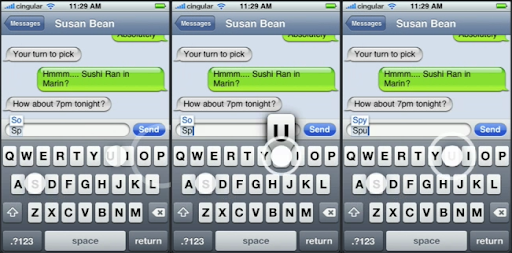
iPhone touch-based keyboard

From left to right:
  1. a finger hovers over the letter 'u' (another is over the letter 's')
  2. the finger touches the screen, prompting visual feedback before the input is actually registered
  3. on release, the letter us is registered and appears in the text input field. Until the release, you get the chance to correctively reposition your finger in the event that 'u' was not your intended keystroke.

The visual feedback you get from letter magnification combined with 'on release' behavior instead of 'on click' behavior suggest that typing will be a breeze on the iPhone. Multi-touch, or the ability to touch different parts of the display at the same time, means fast two (or more) fingered typing.

SOURCE: iPhone UI videos at apple.com

Sunday, April 29, 2007

Let's be realistic

While it's interesting that AT&T may be marketing the iPhone to businesses (I think business people might be more plausible), I thought the reasons a Gartner analyst used in warning against such action was somewhat amusing.
Business customers should also be weary of the iPhone's various other shortcomings, the Gartner analyst said. For instance, he notes that it lacks a physical keyboard, which will make it difficult to dial while driving.

Dial while driving? On second thought, as long as a New Jersey state governor can get seriously hurt in a car accidentcollision while not wearing a seat belt, Ken (the analyst) was just being a realist.

SOURCE: Apple Insider

Saturday, February 17, 2007

Not so sure about the iPhone anymore

Apple's TV ads feature Mac and PC impersonations While the PC and Mac guys depicted in Apple's television commercials are caricatures of America's desktop dichotomy, the stereotype that Windows is for work and Mac [is for fun stuff] seems poised to strengthen when we look at Windows Mobile 6 and the upcoming slimmed down OS X for iPhone. This is at least in part because they inherit the best from their parents with Windows Mobile 6 expressing a stronger synergy with Microsoft Exchange and Office and Apple with iTunes, Mail, Calendar, Address Book, etc.
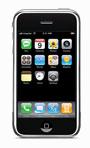
Apple iPhone While Apple's iPod has been long-capable of running more powerful applications than music playback, they have focused on what what's essential to an MP3 player, even deferring video playback until being able to offer an unprecedented experience (i.e. being able to download network TV shows via iTunes). They've done a great job resisting convergence for the sake of convergence. Microsoft had to learn the hard way since bringing the Windows 95 experience to the your hand in the form of Windows CE 1.0. Since then, they've gotten rid of the keyboard, redesigned the interface, gotten rid of the touch screen [(in the successful 'Standard' edition)], then brought the keyboard back, taking years to gain a market dominant position over Palm. Getting the right balance has not been easy. This is certainly proof that convergence is not wrong, but takes serious innovation. Palm Pilot's "we don't need color" approach and Steve Jobs' assertion that "video is a passive experience" are clearly no longer relevant considering Apple's Widescreen iPod of an iPhone and that the last monochrome Palm handheld was a discount stocking stuffer several holiday seasons ago.
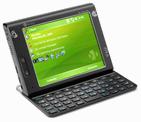
HTC Advantage Windows Mobile 6 stands to be both a winner and a loser in the mobile phone market with its three evolved brands, Standard, Classic and Professional (formerly Smartphone, Pocket PC, and Phone Editions). It may lose some of its niche consumer market to iPhone but also reclaim territory previous lost to RIM's Blackberry. RIM started for push-based email where email is sent directly to a Blackberry without the user having to actively check their email. This was achieved through integration with Microsoft's own Exchange email servers. Microsoft's come a long way, finally beating Palm in terms of shipped devices. Growing on the success of the slimmed down Smartphone Edition that ran on cheaper hardware (sans touchscreen), Microsoft is building into version 5 robust Office document editing features previously only available on more expensive Pocket PC and Phone Editions. Cooler computing-intensive (power-hungry) features like opening up a Unix terminal or controlling a Windows desktop with the Terminal Services Client in VGA resolution are still restricted to what is now called Windows Mobile Professional.
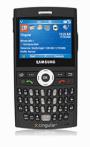
Samsung BlackJack At the cost of a larger touch-screen interface and expensive graphics accelerators found on Windows Mobile Pro, Windows Mobile Standard Edition seems to have matured very nicely from an initially dumbed-down version of Windows Mobile developed for mobile phones to really fleshing out to meet the needs of business users and improving security and manageability. Both the new iPhone and Windows Mobile will have a richer browsing and [Exchange-less push-based] email experience than their competitors. Both purport to suport the dynamic content manipulation via AJAX in web-pages. However, it is exactly the ways in which iPhone is so much like Windows Mobile Standard Edition that I'm becoming more wary of it.
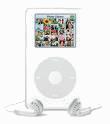
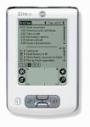
iPod photo Palm Zire 21 These two devices buck the overambitious, all-in-one convergence that had Windows Mobile Professional over-promising and under-delivering. They intend to reinvent the phone by stripping out what was non-essential and perfecting what remained. While Apple's device has seemingly limitless potential and you could argue that it is comparable to a PDA, Apple's closed-system nature restricts third-party developers from making software for the iPhone. This essentially reinforces the concept that the device is less of a converged computing platform than a ... "revolutionary phone, breakthrough internet device, and widescreen iPod".
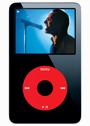
U2 iPod 5.5g HP iPAQ h2215 The iPhone is by far the more ambitious of the two devices because it also promises the best music and video experience. While it's easy enough to throw away (recycle/reuse) both my cell phone and my clearly obsoleted Pocket PC, asking someone to give up their 30GB video-enabled iPod may not be so simple. Of course, we haven't seen the whole story from Apple and maybe there will be a terminal app hiding somewhere on the iPhone enough to convince me to leave behind most of my media content. There it could have been a deliberate decision by Apple to delay third party software development in the beginning to have more control over a very critical stage of the iPhone product line.

References: Windows Mobile Standard Video Demo, Download Squad

Last updated: 1/9/2023 7:56 PM EST (fix broken images)