Here's an interesting write-up about how Android's doing from a developer's perspective. I really thought that if Google really delivered on Android, it would commoditize iPhone, but it seems there are still some challenges the Android team has to iron out that Apple may still have the edge come February when they in turn release the iPhone SDK.
Showing posts with label google. Show all posts
Showing posts with label google. Show all posts
Saturday, December 29, 2007


Wednesday, November 14, 2007
What is Dalvik?
It's interesting that you write Java code for Android but it's not a Java virtual machine that runs the code. It's a Dalvik virtual machine. I didn't look too hard myself, but the source for Dalvik isn't included in the SDK. Read all about Stefano Mazzocchi's analysis of what Dalvik is and isn't.
SOURCE: Wikipedia
SOURCE: Wikipedia
Monday, November 12, 2007
Android to come to iPhone? Please?
I just knew that Android was going to be Java-based. Now, all I want is for Apple to follow up with a related announcement at February's Macworld Expo. There has to be something better to come out of Eric Schmidt being on Apple's board than the Google Maps app for iPhone.
Wednesday, October 10, 2007
Here I go again
If you've read this blog before, you may have been amused my disclosures of owning Apple and Google stock. For about three quarters, I've been clean and have had no financial interest in either company. The company I work for has a policy dictating that discretionary trading must be conducted with the company, so I closed my external account with TD Ameritrade and open a new one with the firm. I did that on Monday because they had a table in the cafeteria and made it very convenient and rewarding. It was convenient because I could take care of the paperwork without touching a fax machine and rewarding because I was promised a BestBuy gift card for applying on the spot.
What I've done in the past is to buy stocks in which I haveblindcomplete faith. This leads to few picks and usually generously valued ones (i.e. Apple or Google). This isn't to say that I've always been successful. Asides from those two, virtually every company I've owned stock in has been de-listed, but not always for bad reasons. The most recent recently delisting was a voluntary one by Creative Technology (CREAF), but I could spend several posts talking about each of my unsuccessful picks.
One straightforward thing I might do is to try and short (or sell) companies who are grossly overvalued. I can still imagine being screwed by the strategy but it seems logical.
What I've done in the past is to buy stocks in which I have
One straightforward thing I might do is to try and short (or sell) companies who are grossly overvalued. I can still imagine being screwed by the strategy but it seems logical.
Saturday, July 21, 2007
It's been said that Facebook is the new Google
An ex-googler who managed Page Creator said that Facebook is "the Google of yesterday, the Microsoft of long ago". Now, I'm not the biggest fan of Page Creator, but when you think of the best places to work, Google is no longer the indisputable choice for most [new ]software engineers [forget Goldman]. Blake Ross, creator of the alternative browser Firefox, co-founded a startup called Parakey to develop a web-based operating system. Now, he's still doing that, but now he's [just ]working for Mark Zuckerberg.
SOURCE: DealBreaker [at which a blogger dramatically understates Blake's contribution to Firefox: "they surfed the net a lot using Firefox, not Explorer"]
SOURCE: DealBreaker [at which a blogger dramatically understates Blake's contribution to Firefox: "they surfed the net a lot using Firefox, not Explorer"]
Thursday, June 07, 2007
Google Mashups and Google Web Toolkit
So it looks like Google Mashups uses GWT to do its magic. At least part of it. Anyhow, I've updated my bitty Zinc, Inc webpage to include a Google Mashup of a photo album. That's not really mashing anything together, but I also I've also done a quick rendering of most of that page which is a bit more of a 'mashup' of different feeds here. One killer feature of Google Mashups that I haven't tried yet is the ability to create your own feeds and update the data behind it.
Here's a real mashup some googlers made: SF Giants Baseball Mashup
SOURCE: Google Mashup Blog
Here's a real mashup some googlers made: SF Giants Baseball Mashup
SOURCE: Google Mashup Blog
Wednesday, December 13, 2006
Google to let employees capitalize on option 'forwarddating'
That's not exactly what's going on, but Google is working with Morgan Stanley to create a market where financial institutions can buy vested options directly from employees via a web-based auction system. The benefit for employees is that they can get more money than they would from exercising the stock on the market as prices will factor in potential growth in the future. Why would banks pay for a premium instead of just buying the stock on the open market?
For one thing, instead of paying say $500 for each share, a bank could just pay $25 on the hopes that in a year, the price will exceed $525. By investing in the options instead of the stock, you increase the potential return because you can buy many more $25 options than $500 stocks. Google explains the bigger picture better in their page "The Market for TSOs" and talks about letting employees capitalize on the time value of their options. Hence, forwarddating as opposed to backdating : ).
The other interesting thing readers of this blog may appreciate is that while Goldman did Google's [last] stock offerings (and I speculated that they handled the YouTube aquisition), Morgan Stanley was picked to handle a technical solution for both their innovative online dutch auction IPO as well as this TSO auction system. [Incidentally, I missed the news that Morgan and CSFB underwrote Google's first secondary offering of (Pi-3)E8 shares.]
SOURCE: Official Google Blog
UPDATED: 12/14/2006 8:06pm EST
For one thing, instead of paying say $500 for each share, a bank could just pay $25 on the hopes that in a year, the price will exceed $525. By investing in the options instead of the stock, you increase the potential return because you can buy many more $25 options than $500 stocks. Google explains the bigger picture better in their page "The Market for TSOs" and talks about letting employees capitalize on the time value of their options. Hence, forwarddating as opposed to backdating : ).
The other interesting thing readers of this blog may appreciate is that while Goldman did Google's [last] stock offering
SOURCE: Official Google Blog
UPDATED: 12/14/2006 8:06pm EST
Tuesday, October 31, 2006
Google Web Toolkit now for Mac OS X!
Google's java-based AJAX widget framework, the GWT, has a new version:
Mac OS X | gwt-mac-1.2.11.tar.gz | 22 MB | d649c6a6e30d4ba942576fb37b329841
SOURCE: GWT Blog
Mac OS X | gwt-mac-1.2.11.tar.gz | 22 MB | d649c6a6e30d4ba942576fb37b329841
SOURCE: GWT Blog
Friday, October 20, 2006
You can trust me now
I'm free from potential conflicts of interests as I've closed my positions in Apple and Google. Sad, but not a bad time, right. Apple still didn't revise the their earnings to take into account the options irregularities, but oh well. No more silly half-hearted disclosures like "the author of this article owns shares of the aforementioned company".
Saturday, October 14, 2006
Behind Google's acquisition of YouTube
You will not get anything out of reading the rest of this post.
Sometimes, the people who don't ask questions know a little something. Following are a list of analysts present during the YouTube acquisition conference call.
Also, if Goldman handled the acquisition details, why have they been getting more Google business? Was it because they got on Google's good side after hanling their secondary stock offering almost for free?.
SOURCE: Seeking Alpha [via Google]
Sometimes, the people who don't ask questions know a little something. Following are a list of analysts present during the YouTube acquisition conference call.
Analysts:

Mary Meeker, Morgan Stanley
Imran Khan, JP Morgan
Doug Anmuth, Lehman Brothers
Mark Rowen, Prudential
Justin Post, Merrill Lynch
Kevin Allison, Financial Times
Daniel Arnell[?], ABC News
Victor Anthony, Bear Stearns
Laura Lach[?], Time Magazine
Also, if Goldman handled the acquisition details, why have they been getting more Google business? Was it because they got on Google's good side after hanling their secondary stock offering almost for free?.
SOURCE: Seeking Alpha [via Google]
Monday, October 09, 2006
YouTube and Google
That's the way to do it:
SOURCE: DealBreaker
It also means that Google just picked up YouTube for about 1 % of its equity. That’s the power of a $125 billion market cap.
SOURCE: DealBreaker
Sunday, September 03, 2006
Top 400/600 Image Labeler
A couple days ago, Google launched a beta product called Image Labeler. It asks people to dedicate 1.5 minutes at a time to tagging images so they become easier to find. It's like a game because you work with an arbitrary partner to cooperate on the task. When you both tag the picture with a common keyword, the picture is matched and you get a new picture. The more images you can successfully tag, the more points you get (as you can see here):

The only bummer is that it's hard to find compatible partners. Dead-beats that give up half-way are frustrating to encounter, but it was good partnering with you, nzodd.
added some context 5:15 PM 9/3
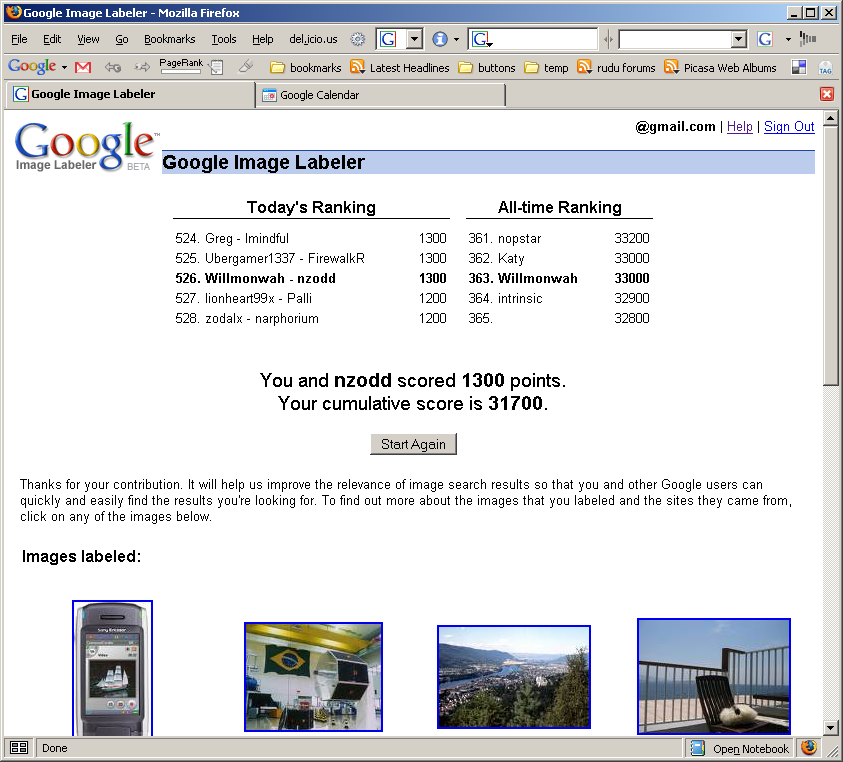
The only bummer is that it's hard to find compatible partners. Dead-beats that give up half-way are frustrating to encounter, but it was good partnering with you, nzodd.
added some context 5:15 PM 9/3
Wednesday, August 30, 2006
Eric Schmidt joins the Apple BOD
Reinforcement! How could I resist posting about this.
Got carried away truncating the URL.. fixed link.
Got carried away truncating the URL.. fixed link.
Sunday, August 27, 2006
Google Software Distributed with Thinkpads
Google is partnering with Lenovo (in addition to Dell) to distribute its desktop software. Excellent, because Google's free software is actually good. Not as good as iPhoto (Picasa) + Spotlight (Google Desktop), but good.
Reference: Spec sheet for Thinkpad X60 (pdf)
Included software (preloaded)I'm not looking to upgrade my Dell, in case you were wondering just checking out stuff for my sister. Bonus: If you missed this on slashdot, an 'inside look' into IBM's mainframe sales force.
Adobe Reader; Diskeeper Lite; Google: Google Toolbar, Google Desktop, Picasa from Google; Multimedia Center for Think Offerings, including: InterVideo WinDVD (DVD, DVD/CD-RW & DVD-RW models), InterVideo WinDVD Creator (DVD-RW models), Sonic RecordNow & DLA (DVD/CD-RW & DVD-RW models); PC-Doctor; Symantec Client Security (with 90 days of virus definitions); ThinkPad Utilities (Power Manager and Presentation Director); ThinkVantage™ Access Connections; ThinkVantage Fingerprint Software, ThinkVantage Productivity Center with Away Manager; ThinkVantage Rescue and Recovery™; ThinkVantage System Update
(downloadable)
ThinkVantage System Migration Assistant
(license–CD not included)
IBM Lotus® SmartSuite,® IBM Lotus Notes® stand-alone client
Reference: Spec sheet for Thinkpad X60 (pdf)
Friday, July 21, 2006
Google Inc. doesn't disappoint
I got a lot more information from the Q/A session than from the prepared portion of the Q2 2006 conference call, but the gist is that Google is happy to have done well in what is a "seasonally weak" quarter. They're stock price didn't change too much at the end of the day, which probably means people are not too surprised. That as opposed to Yahoo, who dropped 20 percent cause they waited too long to announce a delay in their service upgrades.
Here's what I thought was worth sharing from the Q/A session:
SOURCE: their webcast
Here's what I thought was worth sharing from the Q/A session:
- Distribution deals relating to the Google Toolbar (presumably with companies like Adobe) cost Google on the order of 24 million according to a question-asker during the Q/A session.)
- In response to a question about macroeconomic issues, Google remarks anecdotally that after 9-11, while they thought customers would cut back in spending, they experienced accelerated customer aquisition. They take this as a testament to the cost efficacy and reliability of advertising through Google.
- Customers have larger budgets than Google can deliver on, so they're working on increasing inventory (more effective ads like video, increasing number of adsense publishers, ad real estate). In otherwords, when a customer says, place 5000 dollars worth of relevant ads and Google can't satisfy demand.
- Net neutrality: Google doesn't foresee itself being significantly impacted by a compromise of net neutrality. Why? They have good relationships with ISPs and they have good content that is virtually essential. If ISPs were to start charging more for premium content, Google would probably be part of the package. They could probably get into the ISP game themselves in one way or another. They fight for it because it helps internet companies like themselves a couple of years ago (who'll probably be their customers or provide content for them to index). Finally, they mention how while the internet is fast, end-user access is slow and bottlenecked to the point where if ISPs want to upgrade this connectivity for end-users, they'd want to make tons of money from it. However, this seems to only be a problem in the US, as other developed countries don't have that "last mile" bottleneck and don't have an issue with net neutrality. I think that was Sergei talking.
- Google isn't using Google Checkout to charge advertisers per purchase and before doing so would inform users that their data is being used in such a way. Google has a page that explains Checkout very nicely. In principle, Checkout could help people sell stuff with low processing costs no matter how they market it but there are big pluses for AdWords customers. For example, processing is free/discounted proportional to Adwords spending, etc.
SOURCE: their webcast
Thursday, July 01, 2004
Gmail going public as early as August
Google's Brin Talks on Gmail Future
I read an interesting interview with Sergey Brin I found a link to in GmailForum and have compiled a short list of extractions:
- Gmail said and reiterated that Gmail
will[is] likely[to ]come out of Beta in 3-6 months (as of April 23, 2004)! - They are committed to providing IMAP or at least POP3 access and coming up with ways to continue advertising through those channels
- Files are deleted when you delete them, but because they keep a number of backups, it takes longer to delete all the copies
- Future possibilities (with privacy taken very seriously):
- Searching Google to find out whether you have new mail
- Being logged into Orkut and being able to see if you have new mail
- Of course, other new features...
Subscribe to:
Posts (Atom)